Saturday, December 15, 2007

A View From Pointe du Hoc...

Pointe du Hoc, Normandy, France

December 15, 2007
N49°23.762
W000°59.182

Operation Overlord was more than just full scale attack on the beaches of Normandy. At Pointe du Hoc 225 US Army Rangers made an assault on a 30 meter cliff that overlooked both Utah and Omaha beach. It was believed the Germans had large guns mounted at Pointe de Hoc that would cause massive causalities if not destroyed prior to D-Day. The plan was simple… just hours before the assault on Utah and Omaha, the Rangers would land on the beach below the cliffs at low-tide, use rope ladders to scale the huge sea wall (while avoiding enemy fire), capture and destroy the large guns from the Germans, and radio back to command when the job was complete. No problem.

The night before D-Day, the Allied Forces dropped tons of bombs on the areas where the forces would be landing the next day; hopefully forcing some of the Germans out of the area and essentially “softening-up” the beaches prior to the landing. The area around Pointe du Hoc was severely damaged by the bombs the night before; however, the Germans still remained as the Rangers attempted to scale the walls.

As the Rangers tossed their rope ladders up the cliff, the Germans would cut then down and riddle them with small arms fire, a soldier would fall to his death, and another man would take his place, throwing-up his ladder and begin scaling the wall. Their job was to capture the guns and there was no turning back.

After several hours of ferocious combat the US Rangers were able to proudly report that their mission was accomplished, and their brothers, preparing for the attacks on Utah and Omaha beaches, wouldn’t have to worry about the guns at Pointe du Hoc. The Rangers started the day with 225 men and finished with 96.

Today, we had the opportunity to see where the proud Rangers did their work on D-Day. Approximately 30 acres of land surrounding Pointe du Hoc was given to the US Government by France in 1979 and the area remains pretty much the same as it did in 1944. The bomb craters are clearly visible. German bunkers are a bit of a wreck, but they still remain, barbed wire still winds through weeds and mounds of earth, and the massive gun turrets still overlook Omaha to the right and Utah to the left.

We slowly walked through the site, taking our time, looking down the cliff to the sea below, amazed at the bravery and paying respect to the Rangers of Pointe du Hoc. When we were sufficiently frozen, with our scarves wrapped up to our ears, we headed back to the car for a little warmth. We were very happy we took the time to see Pointe du Hoc, another important piece of D-Day history for Americans.

Friday, December 14, 2007

A History Lesson...

Omaha Beach, Normandy, France

December 14, 2007
N49°21.551
W000°51.197

It was another cold winter morning; our breath made large clouds of smoke in front of our faces and frost covered everything in site. Inside the car we were nice and warm, but the temperature outside oscillated between -2 and 1 Celsius. We knew it would be really cold at our destination, Omaha Beach, since the winds would be ripping off of the channel.

We pulled into the nearly empty parking lot of the American Cemetery at Omaha Beach, bundled up in tights under our pants, gloves, scarves, hats and several layers of clothing. We got out slowly, bracing ourselves for the cold and, at the same time, knowing what we were about to see changed the history of the world as we know it today. The soldiers who rest in peace in the cemetery fought for freedom and paid the ultimate price in one of the most infamous battles in history.

As we walked out toward the cemetery, I looked down upon Omaha Beach. There was a steady breeze coming up the bluff making my eyes water, but the waves were calm and the surrounding area beautiful. I tried to imagine the scene in the water on 6 June, 1944, D-Day, and the largest amphibious attack in history of war. The water was full of ships, and Higgins Boats, designed by Andrew Higgins of New Orleans, for this exact moment in history—the day the Allied forces would bring wave after wave of men, in mass force onto the French Coast, reclaiming France from the Germans and, ultimately, defeating Germany.

The boats were designed to unload equipment quickly by dropping a large ramp in the front of the boat. The plan was to get close enough to shore to unload hundreds of thousands of men, tanks and equipment, circle back, and get more of everything to quickly unload. However, the tide was rough that day; the captains of the Higgins Boats couldn’t get close enough as Germans were shooting at them from above, from the exact area where I am standing today. From my vantage point it was clear that anyone on the beach that day would have been an easy target.

For Operation Overlord (code name for D-Day) to be successful, there had to be an element of surprise. The Germans felt the beaches of Normandy were an unlikely location for the Allied forces to attack. The Allied Commanders did their best to confuse the Germans by building false air strips, military bases and leaking false-intelligence to support the German’s belief that the attack would surely happen to the north, in the channel closer to London.

As the men (really young boys, most 18-23 years) were in the waters, headed to their designated beaches, a speech was simultaneously read to all men. In the words of Dwight D. Eisenhower:

“You are about to embark upon the Great Crusade, toward which we have striven these many months. The eyes of the world are upon you. The hopes and prayers of liberty-loving people everywhere march with you. In company with our brave Allies and brothers-in-arms on other Fronts, you will bring about the destruction of the German war machine, the elimination of Nazi tyranny over the oppressed peoples of Europe, and security for ourselves in a free world.”

In the morning of 6 June, 1944, when the Germans looked down onto the water, they were surprised. Literally thousands of ships were off the shore of Utah, Omaha, Gold, Sword and Juno beaches and steady streams of boats were coming ashore. It must have looked overwhelming. The Americans were responsible for Utah and Omaha, unarguably the two toughest beaches.

The rough waters prevented several of the boats from getting close enough to shore for the ramps to work properly. The ramps were lowered, men jumped out, only to find themselves underwater with 90 pounds of equipment on their backs. They had two choices at this point—cut off the pack or drown. Unfortunately, for some, they couldn’t think fast enough and they simply perished before they reached the beach.

The boats that did make it closer had to avoid booby traps created by the Germans. Most of the traps were underwater mines; exploding and killing entire ships of men. The greatly important Sherman tanks drove off the end of the ramp and simply sank into the water. Only two of the tanks actually made it onto the beach that first day. The men who did make it to the beach had very few supplies; some had no guns, no ammunition, no first aid supplies and no food. However, those brave men found a way to survive and persevere.

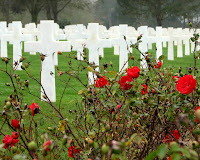
At Omaha, the Americans lost thousands of men, and as Marc and I turned away from the water and looked at the Crosses in the perfectly manicured lawn. There are over 9,000 American soldiers buried in the cemetery; Crosses and Jewish stars, in perfectly lined rows stretched as far as we could see.

We walked across the lawn, reading several of the names, ranks, home states; many perishing in June and July of 1944. I read the names aloud, no one else around to hear, I wondered when the last time anyone uttered their names. Robert Scott, Ruel Sanford, Jimmie Monteith. When was the last time someone thought about these men? Who were their families, who were their friends, what did they imagine they would grow up to be? Most importantly… will they be remembered in another 60 years?

With our faces frozen, our noses running and hands numb, we headed back to the Visitor’s Center. The center shows short movies commemorating some of the men who fought that infamous day. One of the men turned down a promotion to stay in the front line with his comrades; another, a surgeon, asked for a transfer from a safe hospital to care for the injured on the front line, never telling his wife who was home with two kids; and one more, a pilot from Ceres, CA who thought he was invincible after fighting in North Africa and Sicily.

As we walked through the cemetery, we saw a group of French students on a field trip. The teenagers, acting like teenagers, ran through the cemetery, snapped pictures and somewhat listened to their teacher. We wondered if these kids really understand the significance of what the Americans and Allied Forces did for their country 63 years ago, or do they only know the America of today—the one in Iraq under false pretenses. We can only hope future generations continue to understand the importance of 6 June, 1944, D-Day.

“To those we owe the high resolve that the cause for which they died shall live.”


Thursday, December 13, 2007

A Nice Surprise in France...

Dinan, France

December 13, 2007
N48°27.018
W002°02.657

Our journey north through France continued a little before 11:00 AM. We only wanted to make it to a little town named Dinan. According to the map, the drive should be 150 KM; a little less than 100 miles. No problem, after being on the road for several hours yesterday, a two hour drive would be a breeze.

The view across the countryside was much more enjoyable today, especially since all of the fields were covered with frost. It was nice to look out of the car window, but I didn’t want to venture outside since the outside temperature registered at -1C; it definitely sounds warmer when you think of it as 31 degrees Fahrenheit.

Luckily, the drive was very easy (especially since I was the passenger) and we arrived in Dinan a little before 1:00 PM. We found a recommended guest house inside the old castle walls and set out to explore the town. The Old Town, or area within the castle walls, was built in the 14th century; again reminding us how young our country is.

Dinan ended up being a quaint, picturesque, village we thoroughly enjoyed; taking us back to our visit of Cesky Krumlov. At night, the streets inside the castle walls were decorated for Christmas, thousands of lights and trees illuminated our way. We finished our night in at a local pub that has been in business for over 20 years and enjoyed a pint of a French stout and the company of the bartender and a couple locals.

We enjoyed our time in Dinan, even if was only for one night, it was one of those little surprises we’ll look back upon fondly.

Wednesday, December 12, 2007

Passing Through Bordeaux...

Bordeaux, France

December 11, 2007
N44°49.597
W000°33.404

As we passed through Irun, Spain into Hendaye, France, we were instantly thrust into another language and culture. Our quick “si, si” became “we, we,” and our “gracias” became “merci”. After spending the majority of the past two months in Spain and Portugal it was a challenge to just switch gears and turn on our grade school French, if you want to give us that much credit.

Today’s relatively short journey finished in Bordeaux, France where we grabbed a room close to the train station, since we are only staying for one night. Plus, the train station is only a short walk from a restaurant I scouted out and have been looking forward to visiting over the past 2-3 weeks, Cassoulette Café. After tapas and pintxos for nearly every meal over the past two weeks, I was really looking forward to a piping hot cassoulette, the perfect cold weather dish.

I fondly remember my first cassoulette. It was at Angel’s of Russian Hill, a very exclusive, invitation only restaurant in San Francisco. One winter night, when we were invited to the restaurant, the set menu included a savory cassoulette complete with duck confit, chicken, small chunks of pork and haricot beans. The entire dish was baked to perfection in a small casserole dish, with the right amount of bread crumbs on top. As we ate with the chef, we complemented her on the tasty dish; perfect for the cold, foggy San Francisco evening.

It was this exact dish, complete with duck confit and cannelini beans, I envisioned and craved, on this chilly winter evening in Bordeaux, France. I was positive Cassoulette Café, where you pick your ingredients, would provide us, well me, with what I desired. As we walked through the city of Bordeaux, cold winds making our noses and eyes water; I couldn’t stop talking and thinking about the warmth of the dish. We even made sure to walk by the restaurant to ensure it still existed—Marc suspected, with all its build-up, it would be closed-down, like so many other over-hyped restaurants on our trip.

When dinner time rolled around, we bundled up and set out for Cassoulette Café. After we were seated our waiter explained the menu and I quickly realized I wasn’t going to find the savory fare I was looking for. Instead, in France, a cassoulette, or casserole, is anything cooked in a terra cotta casserole dish. The taste of beans, duck and chicken evaporated and I quickly had to male a choice between zucchini or potatoes au gratin.

I have to admit, the dishes were good, but I am still in search of the perfect cassoulette. I hope I don’t have to wait for another invitation from Angel’s of Russian Hill, because as everyone who has been invited knows… the menu is never the same twice!

Monday, December 10, 2007

The Angry Bay of Biscay...

San Sebastian, Spain

December 10, 2007
N43°19.542
W001°59.064

The calm, serene sound from the waves crashing outside our window quickly turned loud and angry, booming and reverberating off of the buildings. The blue waters of the Bay turned frothy and milky white as the waves crashed over the seawall. So large at times they reached the building we’re staying in across the street.

Our room is on the third floor of the building, but it was not spared from the repeated crashes throughout the night. On at least two occasions the waves were so large that they actually reached our balcony, knocking over a chair, a plant, and blasting open the inner door to our bedroom. There were literally gallons of water on the balcony, 3-4 inches deep. On previous nights we slept with our door to the balcony partially open and the storm shutter half way down to let the sweet ocean air into our room. Luckily, maybe it was a premonition; we battened down all the hatches last night.

This morning, after lying awake most of the night due to the merciless sounds of the waves, we opened the wooden door to assess the damage. The balcony floor was covered with dirt from the uprooted plant, the chair on its side, and an inch of saltwater slowly drained into the street. The glass railings protecting the balcony were hazy and covered with sea salt. We could hear the sounds of an electric drill and hammer working feverishly. Where, we do not know. The waves, obviously tired from last night’s performance, were bouncing off of the sea wall, as the sun shone down upon them—at least for a brief moment.

We’ll head out today, our last day in San Sebastian, and continue to explore the city. It will be the first days the stores are open since arriving. Hopefully, as we head out the winds and rains will have died down, and tonight the unforgiving Bay of Biscay will remain calm and allow us to sleep—to enjoy the peaceful, serene sounds of the waves crashing.

---------------------------------------------------------------------

When we finally headed out into the streets this morning, we turned towards the sea and witnessed the destruction from last night’s performance. The railing along the sidewalk promenade was gnarled and tossed aside, a parking meter, uprooted from somewhere, was in the middle of the street still on its concrete base, boulders the size of very large beach balls littered the street. The windows of our building were knocked out on the first and second floors, as was all of the glass to the balconies, the worst damage in the unit just below us.

Each time the wave crashed throughout the night, I could hear the “Whoomp” before it crashed down; however, I had no idea of the damage and destruction the sea was causing only a few feet below us, even tearing the paint off of the exterior wall.

As we stood on the street, taking pictures and making videos, the sea once again splashed over the sea wall, drenching us. I have a feeling the large crashes will relentlessly continue tonight. Maybe we should stay a little further from the water during our trek up the Atlantic Coast.

Sunday, December 09, 2007

An Immaculate Day in Spain...

San Sebastian, Spain

December 9, 2007
N43°19.542
W001°59.064

The waterfront along Playa de la Concha is packed with both tourists, mostly Spanish, and locals alike. Even though people are out walking for exercise, they’re immaculately dressed in furs, jewels and stylish boots. The woman are out strutting their new winter fashions, it’s almost like a catwalk in the middle of December, I bet it’s even crazier in the summertime when the beach is packed with sun worshipers.

We enjoyed the walk along the waterfront. Not only did it allow us to enjoy the views of the Bay of Biscay and dogs and people playing on the beach, but it gave us our daily exercise. When we reached the western end of the walk, we realized we were with the same group of people throughout the walk, we smiled and acknowledged them. Literally, hundreds of people were out walking, enjoying the day, yet another holiday in Spain, Immaculate Conception Day.

The children that were able to reach the end of the promenade were circled around several eight inch holes in the granite walkway. When the surf came in a burst of air would shoot up through the holes, blasting them with a gust of mist and wind. One young girl, who couldn’t have been more than seven, bent over looking directly into the hole as the wind shot-up, it shook all the skin on her face and sent her hair straight up into the air. Other children stood near the rail overlooking the bay, providing warnings of giant waves that were advancing. You knew a big blast of air was just seconds away when the children would scream and run away from the rail; of course, always too slow to avoid the splash of a giant wave, soaking them to the bone.

As we made our way back to the center of town, people were exiting churches and pouring into the streets. Dressed in their Sunday best, many made their way to the closest pintxo’s bar, while others grabbed fresh baguettes and headed home for their holiday meal. Marc pointed out what a strange phenomenon it was that all of the baguettes the women were holding were missing the ends… hmm?

One thing that struck us as being incredibly odd on this day, a weekend, just a mere sixteen days before Christmas, is how all the stores were closed? Not just mercados, but clothing stores, electronic stores, toy stores… pretty much everything except pintxo bars! A holiday weekend, with tons of tourists in town, a great time to make some money as a business owner; it would be unheard of to close-up-shop in the States. But this is one of the best things about being Spanish; it’s all about quality of life. There’s plenty of time to shop before Christmas rolls around. How much time do you really need to by a few gifts? No one seemed to be stressed about the stores all being closed; they were simply enjoying the time with their families and the holiday weekend.

Think about it… maybe the stress Americans feel is self-induced. Maybe we should worry less about the number of presents and constant shopping and worry more about quality time with family, friends, and of course, wine and pintxos!

Friday, December 07, 2007

Smoky, Dingy, Dungeon...

San Sebastian, Spain

December 7, 2007
N43°19.542
W001°59.064

Due to the holiday weekend we had to switch from our comfy, clean pension in the town center of Bilbao to a dingy, smoky room about 1 KM from Parte Vieja, or the old section of town.

It was a long night; the thin walls did little to absorb noise from inside or outside the hotel. It sounded like the street sweepers were doing laps at 1:30 AM, right under our window, and a loud group of guys were having fun at a local hole-in-the-wall bar until at least 3:00 AM. Breathing wasn’t easy either… the ventilation in the room was so bad, at times it smelled like someone was sitting in our room smoking, the smell of cigarette smoke from adjoining rooms filled the halls and permeated the entire building. I think the place goes down as the shittiest places we’ve stayed for the money, also know as, shit-hole to dollar ratio (SH:$).

Luckily, we only had to stay in the den for one night and moved on today; thanking the heavens we pre-booked accommodations in San Sebastian, and hoping we wouldn’t have the same fate.

The local train from Bilbao to San Sebastian made at least twenty stops along the route, taking over 2 ½ hours. However, the 2 ½ hour ride allowed us time to really enjoy the Basque countryside. A light rain fell as we stared out the window at sheep and goats munching on the damp grass of the mountains, dark green rivers ran through small villages, and the final golden leaves of autumn fell from twisted branches.

Now the good news… when we arrived at our pension, we were stunned by the gorgeous views from our room. The room has a large sliding glass door that opens to a balcony overlooking the Bay of Biscay and waves crashing on the rocks and sea wall, shooting water into the air and splashing tourists strolling along Paseo Nuevo. Plus, the room is smoke free.

We’ll fall asleep to the sound of waves tonight instead of rowdy drunks… what a difference a day makes.

Thursday, December 06, 2007

Just a Little Pintxo...

Bilbao, Spain

December 6, 2007
N43°15.788
W002°56.103

The Spanish typically eat their dinner standing at a counter with a glass of wine or beer. An evening consists of visiting several pintxo bars, where you can grab a small bite to eat, and wash it down with a glass of local wine. You can try one or two items at each place, normally the bar’s specialties, and then move on to the next bar for a few more bites. It’s like a continual Happy Hour with outstanding finger food; not shitty, reheated Vienna sausages, stale nachos, or deep fried jalapeno-poppers like you tend to find in the States. Over the past few nights, we avoided the urge to stay at one place and pintxo hopped along with the locals on a quest to find the best of the best.

Pintxos consist of a small slice of bread, normally a baguette, upon which various toppings are placed (fish, cheese, meat, egg, vegetables, etc.). The quality of toppings tend to vary from bar to bar (gourmet to very simple), as does the price, it all depends on the quality of the ingredients and of course the popularity of the bar.

For example, at one place we had delicate mushrooms, sautéed in olive oil, topped with crunchy toasted garlic and a slice of Serrano ham. At another place tuna was mixed with spicy gourmet mustard and topped with anchoas, or anchovies, and oregano. One more hop and we found slices of Spanish bacon with a perfectly cooked quail egg on top. Now that is bacon and eggs! There are some delicacies too, like foie gras… yummy!

My favorite part of hopping from place to place is you never have a big plate of food in front of you, but instead you just nibble. Even though we try something new at each bar, we’re still eating a lot less than we normally would, but probably drinking more wine J.

We scoped out a few more places for tonight, our last night in Bilbao. The good news is, the pintxos will only get better when we move to San Sebastian tomorrow… reportedly the best pintxos in the world!

Wednesday, December 05, 2007

A Jolt and Look at the Guggenheim in Bilbao...

Bilbao, Spain
December 5, 2007
N43°15.788
W002°56.103
After a very long train ride yesterday, our legs were ready to stretch out and explore a new city. We woke up fairly early and hit a local café for our daily jolt, wandered through the rustic, yet trendy, streets of Bilbao, explored the riverside walk and marveled at the architecture of the art-nouveau Guggenheim Museum.
Back to the coffee… the café we visited today has been in business since 1904, and it’s quite the operation. It has the largest espresso machine we’ve ever seen—capable of making eight cups of espesso at a time with two milk steamers, allowing two people to work side-by-side at the same time, and a green LED ticker displaying the time/date and minor café updates. Our café cortado, or espresso with a tad of milk, was by far one of the best we’ve had since Café Trieste in San Francisco.
After two cortados, a wonderful toasted croissant, and being sufficiently wired, we set out to explore the city. The main promenade, Calle Lopez de Haro, decorated with bright blue Christmas lights at night, is buzzing with activity during the day. The people of Bilbao, and those from the surrounding areas, are in full shopping mode for the upcoming holidays. The stores were packed and people filled the streets with plenty of holiday bags under their arms.
We quickly escaped the shopping scene for a more serene environment, the recently renovated river promenade. The riverfront was revamped in 2000 with clear walking and bicycle paths, plenty of runners were out taking advantage of the beautiful path, as we strolled along enjoying the sites including the fabulous Guggenheim Museum.
The sun bounded off the titanium building and its multiple angles; reflecting like light off the scales of a fish. We couldn’t help but to stroll around the entire structure designed by architect, Frank Gehry. Gehry did an excellent job incorporating a fishing theme, a prominent part of Bilboa’s economy; the randomness of the curves was designed to capture the light off the titanium sections that depict boat hulls and the scales of fish. The location is perfect—right along the river.
Our walk continued down the river toward what’s claimed to be the largest public market in Europe. We were pretty close to siesta by this time, so the fish mongers, vegetable sellers and butchers were putting away their goods, but not before we picked up some fresh fruit for lunch.
Tomorrow we’ll hit the market again, to see the action in full force.

Tuesday, December 04, 2007

A Long Train Ride to Somewhere, We Hope...

Bilbao, Spain

December 4, 2007

Another reason we crashed an extra night in Santiago de Compostela is because we knew we were in for another very long train ride to Bilbao. As I write this, I’m sitting on the train, the landscape flying by in the periphery; only six hours into an eleven hour day, that is, if all goes according to plan.

We each have a good book to keep us occupied, but we spent the first few hours of the trip simply enjoying the Spanish countryside as we snaked our way through mountains, along the banks of rivers, past foggy rust colored sleeping vineyards, and golden fields of recently harvested corn and wheat. We passed through several towns during our journey. Most of them small, unassuming; towns that wouldn’t look out of place in the Central Valley of California, the only distinguishing factor being the occasional road sign or advertisement in Spanish.

Luckily, this will be our last long travel day on a train. We’ll have a couple more short rides along the rails, following the northern coast of Spain to San Sebastian before heading further north and back into France. The train system in Europe makes it easy to get around, but who really wants to sit on any mode of transportation for too long? Especially when time is better spent wandering through cities like Santiago de Compostela, Porto, Sintra, or other countless memorable cities we had the opportunity to enjoy during our travels.

Camino de Santiago...

Santiago de Compostela, Spain

December 2-3, 2007
N42°52.773
W008°32.694

The pilgrimage to Santiago de Compostela begins near the southern border of France, in Spain’s Basque Country. People trek several hundred miles to reach the infamous town of Santiago, pray for forgiveness and ask to be blessed in the name of Jesus Christ. The rite is akin to a Muslim’s journey to Mecca, the ultimate experience.

We took the train to Santiago, we didn’t walk through the cold weather along the northern most part of Spain; however, we still appreciated the vibe within the city and the deeper meaning it holds to many. We didn’t meet anyone who completed the pilgrimage on this trip, but Ana, my friend in Barcelona, completed a shorter version of the journey a few years ago with her father. She described the warmth of people in the small towns and villages along the trek; people who took them in, fed them, and, most importantly, provided them encouragement to continue.

The old town is built around the incredible Catedral del Apostol. The massive baroque cathedral and is where the pilgrimage comes to and end. There are town squares built around the church where people congregate. There are views of the church from different angles from around town, but our favorite view was from the park where we could admire all of its beauty. The striking façade and stunning interior does not disappoint those who have walked for days. We’ve seen hundreds of churches during our travels, in fact I can say we’re “churched-out”; however, Catedral del Apostol was something special and actually made us pause… it was very impressive.

We were so moved with the energy in Santiago upon arrival, we decided to spend an extra night walking through the medieval streets, admiring the church, and sampling tapas, regional wine and cheese. It’s a perfect town to rest tired feet and refuel the body and mind after a long trip—regardless of how you got there!

Monday, December 03, 2007

Our Pilgrimage to Santiago...

Santiago de Compostela, Spain

December 1, 2007
N42°52.773
W008°32.694

Throughout our travels we have done our best to avoid back-to-back travel days. It’s tough enough hauling all gear around and spending a day on a train, bus, plane or boat, but when you have to do it two days in a row it will wear on you.

After leaving Coimbra, and unable to make it to Santiago de Compostela in one day, we decided to gut it out and endure back-to-back travel days. Luckily, the first day was a simple hour and a half train ride north to Porto allowing us time to see the city and relax along the Rio Duermo. However, the second day, which was supposed to be six hours maximum, turned into an all day affair…

It was cold, dark and foggy when we stumbled out of our hotel by 6:55 AM; ample time to catch our train from the Porto station at 7:55 AM bound for the medium sized city of Vigo, a 3 hour train ride. The plan was to connect in Vigo, where the trains left every hour for Santiago de Compostela. However, when we were 45 minutes into our train ride to Vigo, the train conductor informed us there had been an accident at the border of Spain and we would have to take a bus from Valenca. Okay, no problemo.

After an uneventful hour long bus ride from the Valenca station we made it to Vigo around noon. Not too bad… we figured we could still get to Santiago by 2:30 and would be sipping some Rioja by 3:30. We headed straight for the ticket counter and bought tickets from Vigo to Santiago. As we were about to turn away from the ticket counter the lady informed us we would have to take a bus to another station and a train from there; apparently the Spanish train problems were wider spread than originally explained, and told to wait for instructions…. hmmm.

I should mention very few people in this region of Spain speak English, so all of the conversations are in Spanish where I understand about 50% of what is being said and Marc about 25%. After each conversation we would look at each other and compare notes, trying to piece together what was being said. It felt like we were in high school and asking each other what answer we got for a particular question on an exam; neither of sure of the correct answer.

To make a long story, and a very long day short, we finally board a train from Vigo at 2:10 PM, after multiple discussions of whether we are really taking a bus or a train. The train then stopped in a small village about 15 miles from Santiago due to yet another “problemo.” After about thirty minutes without any information new discussions about another autobus began to spread throughout the train. Finally, our conductor, who we’ve come to know well, visited our car and explained that we need to vamos on another autobus. Comprende? Of course!

So… we get on another bus to another train station. We get off the bus and back on another train and finally arrive at our destination, Santiago de Compostela, around 5:30 PM. Frustrated, exhausted and giddy that our journey had come to an end, we high-tailed it to the Hotel Alameda and were pleasantly surprised with a room for 40 Euro a night. We showered, ate a light snack and relaxed for a few minutes before hitting the town around 9:00 PM.

Thank goodness the town is really quaint and charming with excellent tapas and wine bars. We already scoped out our favorite by the end of Saturday night… too bad they’re all closed on Sunday and Monday.

Other notes: I have to say congratulations to my nephew’s football team. Kyle Lowe plays for the Whitney Wildcats of Rocklin, CA. They played in the Sac Joaquin Section Division IV title game against the Oakdale Mustangs on Saturday night at the University of the Pacific. Unfortunately, they lost in a very close game. However, his team had a tremendous season and established a tradition of winning and excellence for Whitney’s very young (two year old) program. In June, Kyle will be among the first seniors to graduate from Whitney. I’m sure Kyle and his teammates will be remembered throughout the history of Whitney as the team that founded the winning football traditional. Congratulations to the entire team!

Sunday, December 02, 2007

A Porto Surprise...

Porto, Portugal

November 30, 2007
N41°08.941
W008°35.136

Our train pulled into the Porto station after a short trip from Coimbra. The journey took less than two hours and since we couldn’t get any further north due to train schedules, we decided to spend the night in the city of Porto. After reading reviews in Lonely Planet, we figured we would just blow right through; however, after spending an afternoon in the decorative town, we were happy we stopped and actually wished we budgeted more time. Unfortunately, we’re running short on that valuable commodity known as time. We’ve been traveling for 10 months and only have two more months before our journey comes to an end. Six months ago we would have modified our plans, and stayed a couple more nights in Porto, but with mere days left it’s like counting change to pay for a cup of coffee… every nickel, every penny and every day is precious.

It was late afternoon and shadows were falling across the city famous for Port wine (thus the name). As we rolled down the streets one of the first things we noted were all of the Christmas decorations including an 80 ft. tree. It wasn’t dark enough to light the tree and we knew we would have to swing back by once the sun set to get the full effect of the display.

With warm light still falling, we had the opportunity to wander through and explore several areas of the city, including the riverfront promenade along the Rio Duermo. Porto is undergoing a major renovation with emphasis on restoring the riverfront, the main tourist area which was recently added as a UNESCO heritage site. We browsed through several shops selling tasty port, local artesian cheeses and a variety of olives; stocking up on some cheese and olives for our train ride to Santiago de Compostela the next day.

We found a nice table along the river and enjoyed a couple beers and watched the sun slowly dropped behind the hills. As the sun set, the twinkle of the Christmas lights appeared across the river, almost like stars on the horizon. When the sun fell so did the temperature along the riverfront. Too cold to drink another beer, we said a quick goodbye to a woman we met from San Francisco, and made our way back up the hill toward the city center and the giant Christmas tree.

The large tree was a show in itself. Every ten minutes the tree would start completely dark, after a few seconds shimmering white lights glittered against a dark background, blue stars began to twinkle, then angels illuminated and the tree would turn green. Next, the angels were swapped out for candles and wheat stalks before the tree would light up completely—one section at a time (each section approx. 10 ft.). The tree was by far the most impressive holiday light show we’ve seen to date; with the possible exception of Carlisle Avenue in Sacramento, CA.

Tomorrow we’re headed back to Spain and intend on traveling through some smaller rural towns, it will be fun to see their displays of holiday cheer.

Thursday, November 29, 2007

Let's Eat Some Pig...

Coimbra, Portugal

November 28, 2007
N40°12.230
W008°25.304

Since arriving in Portugal a week ago, we’ve been in search of the authentic Portuguese meal. We read the stories in Anthony Bourdain’s “A Cook’s Tour” how the Portuguese use the entire pig—kidney, entrails, balls and, most importantly, the blood—absolutely everything. We even have old pictures of Marc’s Grandfather standing proud next to a slaughtered pig, hanging, watching the blood drip into a bucket for future use. No matter how hard we’ve searched, we couldn’t find the perfect pig meal… until tonight.

The temperature outside was in the low 40’s and it felt colder near the river. Luckily we found Restaurante Ze Manel, located down a dark alley only a stone’s throw away from our Pensao, and quickly slipped into the cozy little den and warmed up. Ze Manel is well known by locals, but you wouldn’t have known it tonight, it was empty except for a couple locals, an elderly husband and wife sitting at one of the eight small wooden tables in the far back corner. There were handwritten messages on the wall, praising the food. We glanced around as the waiter handed us the menu, scribbled in barely legible Portuguese, and we did our best to decipher the romantic, latin-based language that seems to be a mix of Spanish, French and who-knows-what. We read about the house specialty in our guide book, but I couldn’t remember the name as I pored over the scrawlings on the menu.

I asked about the special and was told the especialidad do casa, or special of the house, is feijoada a leitao, a stew of beans and suckling pig. I ordered the special, while Marc just pointed to a dish with a familiar word, “arroz,” a mix of rice and beans with meat on the side. Our dishes arrived in large soup bowls with deep ladles. Mine had a side of rice and Marc’s a side tray of pork in olive oil and garlic; pleasant aromas instantly filled our table.

My beans were cooked slowly in a red wine sauce that acted as a tasty gravy to spoon over the rice. Various pieces of pork were perfectly blended into the beans. There were tender pieces that shredded with just the touch of a fork, chunks of sausage, presumably blood sausage, and smaller crunchy pieces, like bacon. I didn’t worry about what I was eating, but instead I allowed the flavors to mix in my mouth as I slowly enjoyed each bite.

Marc’s dish was equally as scrumptious. His beans were served directly with the rice in a soupy mix; however, his dish didn’t have the red wine base my beans needed to complement the pork. The pork chops served on the side, were grilled and then sautéed in olive oil and garlic, blending perfectly with the mellow sauce from the rice and beans. The chunks of sautéed garlic were a nice addition every three to four bites.

As we sat in the small restaurant, listening to the sounds of a soccer game coming from the television in the kitchen, Marc recalled eating Portuguese beans during Thursday Night Meals at the Neugebauer’s house. Every Thursday night, during high school football season, a different mother would volunteer to cook dinner for the entire team. Other mother’s would help, but one family would host, the team would eat together, and enjoy the camaraderie as they discussed last minute tactics for the following night’s game. When Mrs. Neugebauer hosted the dinners she would cook up a giant pot of her famous Portuguese beans complete with fresh pork. Marc forgot all about the beans until one of the legumes hit his mouth. He remembered a few of the other meals, but dinner at the Neugebauer’s was definitely one of his favorite and most memorable.

I never knew pork and beans could taste so good, but tonight, on a cold night in Coimbra, they sure hit the spot.

Zipping Through the Countryside...

Coimbra, Portugal

November 28, 2007
N40°12.230
W008°25.304

Today was an easy travel day, relatively speaking. We caught a train back to Lisbon, made two connections via the Lisbon Metro to get to another train station and then boarded a direct train to Coimbra, a university town in the middle of Portugal. The total trip took a little under four hours and the easiest part was the ride from Lisbon as the train from the city zipped through the rural areas of the countryside at over 120 MPH. The landscape of small houses, hills and farmland was hard to track as we whizzed by.

The town, known as the “Oxford” of Portugal, rests along the Rio Mondego and used to be the capital of Portugal up until the 13th century. It’s now a college town, with annual beer bashes sponsored by the large beer companies, and houses one of the first universities in Europe, the first in Portugal. It’s a steep climb up cobbled lanes to reach the University, situated high above the town over-looking the river. The route definitely gives the students a daily dose of exercise and, most certainly, provides them with a feeling of satisfaction as they looked down upon the city, knowing they’re attending the preeminent university in Portugal.

Another perfect fall afternoon allowed us to casually stroll through the campus and surrounding parks wearing little more than light sweaters. We made mental notes of picture opportunities for tomorrow, when the sun would be higher in the sky, and decided we would retrace part of our walk. Sidewalk cafes were packed with people enjoying their late afternoon fix of espresso. In the square, crews of city employees were just getting started with setting up Christmas decorations; definitely later than the other cities in Portugal.

We plan to relax and enjoy our few days in the college town. Don’t worry, we won’t try to drink with the students—we wouldn’t have a chance of keeping up with them.